

When Did The Nintendo Ds Come Out
 | |
 An electrical bluish Nintendo DS | |
| Likewise known as | iQue DS (China) |
|---|---|
| Developer | Nintendo |
| Manufacturer | Foxconn |
| Product family unit | Nintendo DS family unit |
| Type | Handheld game panel |
| Generation | Seventh generation |
| Release date |
|
| Introductory toll | US$149.99[ane] |
| Discontinued | Yeah; engagement undisclosed[2] |
| Units sold | 154.02 meg worldwide (as of June thirty, 2016[update]) [iii] (details) |
| Media | Nintendo DS Game Card Game Boy Advance Game Pak |
| CPU | 67 MHz ARM946E-Due south 33 MHz ARM7TDMI |
| Retention | iv MB RAM |
| Storage | Cartridge salvage 256 KB flash memory |
| Display | Two TFT LCDs, 256 × 192 pixels |
| Connectivity | Wi-Fi (802.11b, WEP) |
| Online services | Nintendo Wi-Fi Connection |
| Best-selling game | New Super Mario Bros., thirty.80 million (as of September thirty, 2016[update]) [four] |
| Astern compatibility | Game Boy Advance |
| Predecessor | Game Boy Advance |
| Successor | Nintendo 3DS |
| Related articles | Nintendo DS Lite Nintendo DSi Nintendo DSi Xl |
The Nintendo DS [a] is a handheld game panel produced by Nintendo, released globally across 2004 and 2005. The DS, an initialism for "Developers' System" or "Dual Screen",[five] introduced distinctive new features to handheld games: two LCD screens working in tandem (the bottom i being a touchscreen), a born microphone and support for wireless connectivity.[six] Both screens are encompassed within a clamshell design similar to the Game Male child Accelerate SP. The Nintendo DS likewise features the power for multiple DS consoles to direct interact with each other over Wi-Fi within a short range without the need to connect to an existing wireless network. Alternatively, they could interact online using the at present-defunct Nintendo Wi-Fi Connection service. Its principal competitor was Sony's PlayStation Portable during the seventh generation of video game consoles.
Prior to its release, the Nintendo DS was marketed as an experimental "third pillar" in Nintendo'south console lineup, meant to complement the Game Boy Advance family and GameCube. Yet, backward compatibility with Game Boy Advance titles and strong sales ultimately established it as the successor to the Game Boy series.[7] On March 2, 2006, Nintendo launched the Nintendo DS Low-cal, a slimmer and lighter redesign of the original Nintendo DS with brighter screens and a longer lasting battery. On November ane, 2008, Nintendo released the Nintendo DSi, another redesign with several hardware improvements and new features, although information technology lost backwards compatibility for Game Boy Advance titles and a few DS games that used the GBA slot. On November 21, 2009, Nintendo released the Nintendo DSi Xl, a larger version of the DSi.
All Nintendo DS models combined accept sold 154.02 million units,[8] making information technology the best-selling Nintendo system, the acknowledged handheld game panel to date, and the second best-selling video game console of all time, overall, behind Sony'south PlayStation ii.[iii] [9] The Nintendo DS was succeeded by the Nintendo 3DS in February 2011.
History [edit]
Development [edit]
Evolution on the Nintendo DS began around mid-2002, following an original idea from old Nintendo president Hiroshi Yamauchi nearly a dual-screened console.[10] On November thirteen, 2003, Nintendo announced that information technology would be releasing a new game production in 2004. The visitor did non provide many details, but stated it would not succeed the Game Male child Advance or GameCube.[11] On January twenty, 2004, the console was announced nether the codename "Nintendo DS".[12] Nintendo released only a few details at that time, saying that the panel would have two carve up, iii-inch TFT LCD display panels, separate processors, and upwardly to one gigabit (128 Megabytes) of semiconductor memory.[12] [13] Current Nintendo president at the time, Satoru Iwata, said, "We take developed Nintendo DS based upon a completely unlike concept from existing game devices in order to provide players with a unique amusement experience for the 21st century."[12] He as well expressed optimism that the DS would help put Nintendo back at the forefront of innovation and motion away from the bourgeois image that has been described most the company in years past.[14] In March 2004, a document containing most of the console'south technical specifications was leaked, too revealing its internal development name, "Nitro".[xv] In May 2004, the console was shown in prototype grade at E3 2004, still under the name "Nintendo DS".[xvi] On July 28, 2004, Nintendo revealed a new pattern that was described as "sleeker and more than elegant" than the 1 shown at E3 and announced Nintendo DS as the device'due south official proper name.[17] Post-obit lukewarm GameCube sales, Hiroshi Yamauchi stressed the importance of its success to the visitor's future, making a statement which can be translated from Japanese as, "If the DS succeeds, we will rise to heaven, merely if it fails we will sink to hell."[18] [19]
Launch [edit]
President Iwata referred to Nintendo DS as "Nintendo'south commencement hardware launch in support of the basic strategy 'Gaming Population Expansion'" because the touch-based device "allows users to play intuitively".[20] On September twenty, 2004, Nintendo announced that the Nintendo DS would be released in North America on November 21, 2004, for United states$149.99.[21] It was prepare to release on December two, 2004, in Japan for JP¥xv,000;[22] on February 24, 2005, in Australia for A$199.95;[23] and on March 11, 2005, in Europe for €149.99 (£99.99 in the United kingdom).[24] The console was released in North America with a midnight launch event at Universal CityWalk EB Games in Los Angeles, California. The panel was launched quietly in Japan compared to the North America launch; one source cited the cold weather as the reason.[25] Regarding the European launch, Nintendo President Satoru Iwata said this:
Europe is an extremely important market place for Nintendo, and we are pleased we can offer such a short period of time between the US and European launch. We believe that the Nintendo DS will change the way people play video games and our mission remains to expand the game play feel. Nintendo DS caters for the needs of all gamers whether for more dedicated gamers who want the real challenge they wait, or the more coincidental gamers who desire quick, option up and play fun.[26]
Northward America and Japan [edit]
The Nintendo DS was launched in Due north America for United states$149.99 on November 21, 2004; in Japan for JP¥xv,000 on December 2 in the color "Titanium". Well over iii million preorders were taken in Due north America and Nihon; preorders at online stores were launched on November 3 and ended the same day as merchants had already sold their allotment. Initially, Nintendo planned to evangelize 1 million units combined at the North American and Japanese launches; when information technology saw the preorder numbers, it brought another factory online to ramp upward production. Nintendo originally slated 300,000 units for the U.S. debut; 550,000 were shipped, and just over 500,000 of those sold through in the get-go week. After in 2005, the manufacturer suggested retail price for the Nintendo DS was dropped to United states$129.99.
Both launches proved to be successful, but Nintendo chose to release the DS in North America prior to Japan, a start for a hardware launch from the Kyoto-based company. This choice was made to get the DS out for the largest shopping twenty-four hour period of the yr in the U.S. (the twenty-four hours afterwards Thanksgiving, likewise known every bit "Blackness Friday").[27] Perhaps partly due to the release appointment, the DS met unexpectedly loftier demand in the United States, selling 1 1000000 units by Dec 21, 2004. By the end of Dec, the total number shipped worldwide was 2.8 million, near 800,000 more than Nintendo's original forecast.[28] At least 1.2 million of them were sold in the U.S. Some industry reporters referred to it as "the Tickle Me Elmo of 2004".[29] In June 2005, Nintendo informed the press that a total of half-dozen.65 1000000 units had been sold worldwide.[30]
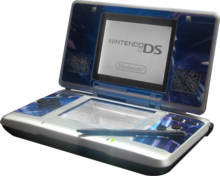
A Nintendo DS, skinned in blue
As is normal for electronics, some were reported as having problems with stuck pixels in either of the two screens. Render policies for LCD displays vary between manufacturers and regions, however, in North America, Nintendo has called to replace a system with stock-still pixels just if the owner claims that it interferes with their gaming experience. There were two exchange programs in place for North America. In the first, the possessor of the defective DS in question would provide a valid credit card number and, afterward, Nintendo would ship a new DS system to the owner with aircraft supplies to return the defective system. In the second, the owner of the defective DS in question would have shipped their system to Nintendo for inspection. Afterwards inspection, Nintendo technicians would have either shipped a replacement system or fixed the defective system. The commencement option allowed the possessor to have a new DS in 3–5 business days.
Multiple games were released alongside the DS during its N American launch on November 21, 2004. At launch there was one pack-in demo, in addition to the built-in PictoChat plan: Metroid Prime number Hunters: First Hunt (published by Nintendo and is a demo for Metroid Prime number Hunters, a game released in March 2006). At the time of the "Electric Blue" DS launch in June 2005, Nintendo bundled the system with Super Mario 64 DS.
In Japan, the games were released at the same fourth dimension as the arrangement'southward first release (December 2, 2004). In the launch period, The Prince of Tennis 2005 -Crystal Drive- (Konami) and Puyo Puyo Fever (Puyo Pop Fever) (Sega) were released.
Europe [edit]
The DS was released in Europe on March 11, 2005, for €149. A small supply of units was available prior to this in a package with a promotional "VIP" T-shirt, Metroid Prime Hunters - Get-go Hunt, a WarioWare: Touched! demo and a pre-release version of Super Mario 64 DS, through the Nintendo Stars Catalogue; the bundle was priced at £129.99 for the UK and €189.99 for the rest of Europe, plus one,000 of Nintendo'south "star" loyalty points (to cover postage). As of 23 January 2006[update], ane million DS units had been sold in Europe, setting a sales record for a handheld console.
The European release of the DS, like the U.S., was originally packaged with a Metroid Prime Hunters: Commencement Hunt demo. The European packaging for the console is noticeably more "aggressive" than that of the U.Due south./Japanese release.[ clarification needed ] [ citation needed ] The European game cases are additionally about ane/4 inch thicker than their North American counterparts and transparent rather than solid black. Inside the case, there is room for one Game Male child Accelerate game pak and a DS card with the instructions on the left side of the example.
Australia and New Zealand [edit]
The DS launched in Commonwealth of australia and New Zealand on February 24, 2005. Information technology retailed in Australia for AU$199 and in New Zealand for NZ$249. Similar the North American launch, it includes the Metroid Prime Hunters - Get-go Chase demo. The first week of sales for the system broke Australian launch sales records for a console, with nineteen,191 units sold by the 27th.
China [edit]
"iQue DS", the official name of the Chinese Nintendo DS, was released in China on June xv, 2005. The cost of the iQue DS was 980 RMB (roughly U.s.$130) as of April 2006. This version of the DS includes updated firmware to block out the apply of the PassMe device, along with the new Red DS. Chinese launch games were Zhi Gan Yi Bi (Polarium) (Nintendo/iQue) and Momo Waliou Zhizao (WarioWare: Touched!) (Nintendo/iQue). The iQue was besides the proper noun of the device that Cathay received instead of the Nintendo 64.
Games available on launch [edit]
| Title | Publisher | NA | JP | Eu | AU & NZ |
|---|---|---|---|---|---|
| Cobblestone Urban GT | Ubisoft |  |  | | |
| Daigasso! Band Brothers | Nintendo | | | | |
| Feel the Magic: XY/Twenty (aka Projection Rub) | Sega | | | | |
| Kensyūi Dokuta Tendo (literally "Resident Physician Tendo") | Fasten Chunsoft | | | | |
| Madden NFL 2005 | Electronic Arts | | | | |
| Mahjong Taikai | Koei | | | | |
| Metroid Prime Hunters: First Hunt | Nintendo | | | | |
| Mr. Driller Drill Spirits | Namco | | | | |
| Ping Pals | THQ | | | | |
| Pokémon Nuance | Nintendo | | | | |
| Polarium | Nintendo | | | | |
| Rayman DS | Ubisoft | | | | |
| Retro Atari Classics | Atari | | | | |
| Robots | VU Games | | | | |
| Spider-Homo 2 | Activision | | | | |
| Sprung | Ubisoft | | | | |
| Super Mario 64 DS | Nintendo | | | | |
| Tiger Woods PGA Bout | Electronic Arts | | | | |
| The Urbz: Sims in the City | Electronic Arts | | | | |
| WarioWare: Touched! | Nintendo | | | | |
| Zoo Keeper | Success | | | | |
| Zunō ni Asekaku Game Series Vol.one: Cool104 Joker & Setline | Aruze | | | | |
Promotion [edit]
The system's promotional slogans revolve effectually the word "Bear on" in nigh all countries, with the Due north American slogan being "Touching is good."[31]
The Nintendo DS was seen by many analysts to be in the same market as Sony'southward PlayStation Portable, although representatives from both companies stated that each system targeted a different audience.[32] [33] [ citation needed ] Fourth dimension mag awarded the DS a Gadget of the Week honour.[34]
At the time of its release in the United States, the Nintendo DS retailed for United states of america$149.99. The price dropped to US$129.99 on August 21, 2005, 1 24-hour interval before the releases of Nintendogs and Advance Wars: Dual Strike.
Nine official colors of the Nintendo DS were available through standard retailers. Titanium-colored units were bachelor worldwide, Electrical Blue was sectional to North and Latin America. There was also a ruby-red version which was bundled with the game Mario Kart DS. Graphite Blackness, Pure White, Turquoise Blue, and Candy Pink were available in Japan. Mystic Pinkish and Cosmic Bluish were bachelor in Australia and New Zealand. Japan's Candy Pink and Commonwealth of australia's Cosmic Bluish were also available in Europe and North America through a Nintendogs parcel, although the colors are merely referred to equally pink and bluish; nonetheless, these colors were available only for the original style Nintendo DS; a unlike and more than-limited set of colors were used for the Nintendo DS Light.
Sales [edit]
As of March 31, 2016, all Nintendo DS models combined take sold 154.02 million units, making information technology the all-time-selling handheld game console to date, and the second best-selling video game console of all time.[3] [35]
Legacy [edit]
The success of the Nintendo DS introduced touchscreen controls and wireless online gaming to a wide audition. According to Damien McFerran of Nintendo Life, the "DS was the offset encounter many people had with bear on-based tech, and it left an indelible impression."[36]
The DS established a large casual gaming market place, attracting large non-gamer audiences and establishing touchscreens equally the standard controls for hereafter portable gaming devices. Co-ordinate to Jeremy Parish, writing for Polygon, the Nintendo DS laid the foundations for touchscreen mobile gaming on smartphones. He stated that the DS "had basically primed the entire earth for" the iPhone, released in 2007, and that the DS paved the style for iPhone gaming mobile apps. However, the success of the iPhone "effectively acquired the DS market place to implode" by the early 2010s, according to Parish.[37]
The DS also enlarged the market for female gamers. According to Nintendo in 2006, 44% of DS owners were female, with the majority of Nintendogs owners beingness female.[38]
The success of the DS paved the way for its successor, the Nintendo 3DS, a handheld gaming console with a similar dual-screen setup that can display images on the top screen in stereoscopic 3D.[39]
On Jan 29, 2014, Nintendo announced that Nintendo DS games would be added to the Wii U's Virtual Console, with the first game, Encephalon Historic period: Train Your Encephalon in Minutes a Day!, being released in Japan on June 3, 2014.[40] [41]
Hardware [edit]
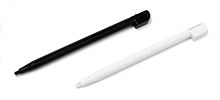
The Nintendo DS[42] design resembles that of the multi-screen games from the Game & Watch line, such as Ass Kong and Zelda, which was likewise made by Nintendo.
The lower display of the Nintendo DS is overlaid with a resistive touchscreen designed to accept input from the included stylus, the user's fingers, or a curved plastic tab fastened to the optional wrist strap. The touchscreen lets users collaborate with in-game elements more than directly than by pressing buttons; for example, in the included chatting software, PictoChat, the stylus is used to write letters or draw.
The handheld features four lettered buttons (X, Y, A, B), a directional pad, and Start, Select, and Power buttons. On the top of the device are two shoulder buttons, a game menu slot, a stylus holder and a power cable input. The lesser features the Game Male child Accelerate game carte slot. The overall button layout resembles that of the Super Nintendo Entertainment System controller. When using backward compatibility manner on the DS, buttons X and Y and the touchscreen are not used every bit the Game Boy Advance line of systems do not feature these controls.
It too has stereo speakers providing virtual surround sound (depending on the software) located on either side of the upper display screen. This was a first for a Nintendo handheld, equally the Game Boy line of systems had only supported stereo sound through the use of headphones or external speakers. A built-in microphone is located below the left side of the bottom screen. It has been used for a diversity of purposes, including speech recognition, chatting online betwixt and during gameplay sessions, and minigames that require the player to blow or shout into it.
Technical specifications [edit]
| Mass | 275 g (nine.seven oz) |
|---|---|
| Dimensions | When closed: 148.7 mm (5.85 in) x 84.7 mm (3.33 in) ten 28.9 mm (ane.14 in) (width x height x depth) |
| Brandish | 2 TFT LCD screens: 62 mm × 46 mm (two.iv in × 1.viii in), 77 mm (three.0 in) diagonal, 0.24 mm dot pitch, 18-bit depth (262,144 colors), 21 mm gap between screens (≈92 lines) |
| Resolution | 256 × 192 pixels (4:3 aspect ratio) for each screen |
| Audio | Stereo with 16 PCM/ADPCM channels facilitated past Mitsumi MM3205B |
| CPU | Two ARM processors:
|
| RAM | 4 MB PSRAM (expandable via the Game Boy Advance slot, merely officially used by the Nintendo DS Browser) |
| Input |
|
| Voltage | 1.65 v |
| Battery | Rechargeable 850 mAh lithium-ion battery |
| Storage | 256 kB of serial flash retentiveness |
| Wireless connectivity | Built-in 802.11 wireless network connectedness (WEP encryption support only)[44] |
The system'due south 3D hardware[42] [45] consists of rendering engine and geometry engine which perform transform and lighting, Transparency Automobile Sorting, Transparency Effects, Texture Matrix Effects, 2D Billboards, Texture Streaming, texture-coordinate transformation, perspective-correct texture mapping, per-pixel Alpha Exam, per-archaic alpha blending, texture blending, Gouraud Shading, cel shading, z-buffering, Due west-Buffering, 1bit Stencil Buffer, per-vertex directional lighting and simulated betoken lighting, Depth Test, Stencil Test, Return to Texture, Lightmapping, Environment Mapping, Shadow Volumes, Shadow Mapping, Distance Fog, Edge Marking, Fade-In/Fade-Out, Edge-AA. Sprite special furnishings: scrolling, scaling, rotation, stretching, shear. However, it uses betoken (nearest neighbour) texture filtering, leading to some titles having a blocky advent. Dissimilar near 3D hardware, it has a set limit on the number of triangles it can render every bit role of a single scene; the maximum corporeality is well-nigh 6144 vertices, or 2048 triangles per frame. The 3D hardware is designed to render to a single screen at a time, so rendering 3D to both screens is hard and decreases functioning significantly. The DS is mostly more limited by its polygon budget than its pixel fill rate. There are too 512 kilobytes of texture retention, and the maximum texture size is 1024 × 1024 pixels.
The organization has 656 kilobytes of video memory[46] and two 2D engines (i per screen). These are similar to (but more powerful than) the Game Boy Advance's single 2d engine.
The Nintendo DS has compatibility with Wi-Fi (IEEE 802.11 (legacy style)). Wi-Fi is used for accessing the Nintendo Wi-Fi Connection, compete with other users playing the same Wi-Fi uniform game, PictoChat[47] or with a special cartridge and RAM extension, scan the net.
Nintendo claims the bombardment lasts a maximum of 10 hours under ideal conditions on a total iv-60 minutes charge. Battery life is affected by multiple factors including speaker volume, use of one or both screens, use of wireless connectivity, and use of backlight, which can be turned on or off in selected games such equally Super Mario 64 DS. The battery is user-replaceable using only a Phillips-head screwdriver. After about 500 charges the bombardment life starts dropping.[48]
Users tin can shut the Nintendo DS system to trigger its 'sleep' way, which pauses the game being played and saves battery life by turning off the screens, speakers, and wireless communications; nonetheless, closing the system while playing a Game Male child Advance game will not put the Nintendo DS into sleep fashion, and the game will go along to run commonly. Certain DS games (such equally Animal Crossing: Wild Globe) besides will not pause merely the backlight, screens, and speakers will turn off. Additionally, when saving the game in sure games,[49] the DS will not go into sleep mode.[50] Some games, such as The Legend of Zelda: Phantom Hourglass even utilize the closing movement needed to enter sleep fashion equally an unorthodox way of solving puzzles. Looney Tunes: Duck Amuck has a game way in which you need to shut the DS to play, helping Daffy Duck hunt a monster with the shoulder buttons.
Accessories [edit]
Although the secondary port on the Nintendo DS does accept and support Game Boy Accelerate cartridges (but not Game Boy or Game Male child Color cartridges), Nintendo emphasized that the chief intention for its inclusion was to allow a wide diversity of accessories to be released for the organisation.
Due to the lack of a second port on the Nintendo DSi, it is not compatible with any accessory that uses it.
Rumble Pak [edit]
The Rumble Pak was the commencement official expansion slot accessory. In the form of a Game Boy Advance cartridge, the Rumble Pak vibrates to reverberate the activity in compatible games, such every bit when the player bumps into an obstacle or loses a life. Information technology was released in Due north America and Japan in 2005 bundled with Metroid Prime Pinball.[51] In Europe, information technology was commencement available with the game Actionloop, and afterward Metroid Prime Pinball. The Rumble Pak was also released separately in those regions.
Headset [edit]
The Nintendo DS Headset is the official headset for the Nintendo DS. It plugs into the headset port (which is a combination of a standard three.5 mm (ane/8 in) headphone connector and a proprietary microphone connector) on the bottom of the organization. Information technology features one earphone and a microphone, and is compatible with all games that apply the internal microphone. It was released alongside Pokémon Diamond and Pearl in Japan, North America, and Commonwealth of australia.
Browser [edit]
On February 15, 2006, Nintendo appear a version of the cross-platform web browser Opera for the DS system.[52] The browser tin use one screen equally an overview, a zoomed portion of which appears on the other screen, or both screens together to present a single tall view of the folio.[53] The browser went on sale in Japan and Europe in 2006,[54] [55] and in North America on June 4, 2007.[56] Browser operation requires that an included memory expansion pak is inserted into the GBA slot. The DSi has an internet browser available for download from the Nintendo DSi shop for gratuitous.[57]
Wi-Fi USB Connector [edit]
This USB-flash-disk-sized accessory plugs into a PC's USB port and creates a miniature hotspot/wireless access point, assuasive a Wii and up to five Nintendo DS units to access the Nintendo Wi-Fi Connection service through the host computer's Internet connection. When tried under Linux and Mac, it acts as a regular wireless adapter, connecting to wireless networks, an LED blinks when at that place is information being transferred. There is also a hacked driver for Windows XP/Vista/7/8/ten to brand information technology office the same way. The Wi-Fi USB Connector was discontinued from retail stores.
MP3 Player [edit]
The Nintendo MP3 Actor (a modified version of the device known as the Play-Yan in Japan) was released on December eight, 2006, by Nintendo of Europe at a retail toll of £29.99/€30. The addition uses removable SD cards to store MP3 audio files, and can be used in any device that features support for Game Male child Advance cartridges; yet, due to this, information technology is express in terms of its user-interface and functionality, as it does not support using both screens of the DS simultaneously, nor does information technology brand utilize of its touch-screen capability. It is not compatible with the DSi, due to the lack of the GBA slot, but the DSi includes a music role player via SD card. Although it stated on the box that it is merely compatible with the Game Male child Micro, Nintendo DS and Nintendo DS Calorie-free, it is too uniform with the Game Boy Advance SP and Game Boy Advance.
Guitar grip controller [edit]
The Guitar grip controller comes packaged with the game Guitar Hero: On Tour and is plugged into the GBA game slot. It features four colored buttons like the ones found on regular Guitar Hero guitar controllers for the stationary consoles, though information technology lacks the fifth orange button found on the guitar controllers. The DS Guitar Hero controller comes with a pocket-sized "pick-stylus" (which is shaped like a guitar pick, as the proper noun suggests) that can be put away into a pocket-size slot on the controller. It too features a hand strap. The game works with both the DS Lite and the original Nintendo DS as it comes with an adapter for the original DS.[58] The Guitar Grip also works with its sequels, Guitar Hero On Bout: Decades, Guitar Hero On Bout: Modern Hits, and Ring Hero.
Later models [edit]
Nintendo DS Lite [edit]

The Nintendo DS Low-cal [b] is the get-go redesign of the Nintendo DS. While retaining the original model'due south basic characteristics, information technology features a sleeker appearance, larger stylus, longer lasting battery, and brighter screens.[59] Nintendo considered a larger model of the Nintendo DS Calorie-free for release, but decided confronting it every bit sales of the original redesign were yet stiff. It was the final DS to have backwards compatibility with Game Boy Accelerate games.[60] As of March 31, 2014, shipments of the DS Lite had reached 93.86 1000000 units worldwide, according to Nintendo.[3]
Nintendo DSi [edit]
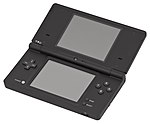
The Nintendo DSi [c] is the second redesign of the Nintendo DS. Information technology is based on the unreleased larger Nintendo DS Lite model. While like to the previous DS redesign, new features include two inner and outer 0.3 megapixel digital cameras, a larger 3.25 inch display, internal and external content storage, compatibility with WPA wireless encryption, and connectivity to the Nintendo DSi Shop.

The Nintendo DSi XL (DSi LL in Japan) features larger screens, and a greater overall size, than the original DSi. It is the 4th DS model, the first to be available equally a pure size variation.[61] Information technology features larger screens with wider view angles, improved battery life, and a greater overall size than the original DSi.[62] [63] While the original DSi was specifically designed for individual use, Nintendo president Satoru Iwata suggested that DSi XL buyers give the console a "steady place on a table in the living room", so that it might be shared by multiple household members.[61]
Software and features [edit]
Nintendo Wi-Fi Connection [edit]

Nintendo Wi-Fi Connectedness Logo
Nintendo Wi-Fi Connexion was a free online game service run past Nintendo. Players with a compatible Nintendo DS game could connect to the service via a Wi-Fi network using a Nintendo Wi-Fi USB Connector or a wireless router. The service was launched in North America, Australia, Nihon & Europe throughout November 2005. An online compatible Nintendo DS game was released on the same solar day for each region.
| Region | Launch Appointment | Compatible Launch Title | Ref. |
|---|---|---|---|
| North America | November 14, 2005 | Mario Kart DS | [64] |
| Australia | November 17, 2005 | Mario Kart DS | [65] |
| Japan | November 23, 2005 | Brute Crossing: Wild Earth | [66] |
| Europe | Nov 25, 2005 | Mario Kart DS | [67] |
Additional Nintendo DS Wi-Fi Connexion games and a dedicated Nintendo DS spider web browser were released afterward. Nintendo subsequently believed that the online platform'due south success directly propelled the commercial success of the entire Nintendo DS platform. The Nintendo Wi-Fi Connection served as part of the basis of what would go the Wii.[68] Most functions (for games on both the DS and Wii consoles) were discontinued worldwide on May xx, 2014.[69]
Download Play [edit]
With Download Play, it is possible for users to play multiplayer games with other Nintendo DS systems, and afterwards Nintendo 3DS systems, using merely one game card. Players must accept their systems within wireless range (up to approximately 65 anxiety) of each other for the invitee organization to download the necessary data from the host organization. Just certain games supported this feature and ordinarily played with much more limited features than the total game immune.
Download Play is likewise utilized to migrate Pokémon from fourth generation games into the fifth generation Pokémon Blackness and White, an example of a task requiring two dissimilar game cards, two handheld units, but only 1 thespian.
Some Nintendo DS retailers featured DS Download Stations that allowed users to download demos of current and upcoming DS games; yet, due to retentivity limitations, the downloads were erased once the system was powered off. The Download Station was fabricated up of i to 8 standard retail DS units, with a standard DS carte du jour containing the demo data. On May 7, 2008, Nintendo released the Nintendo Channel for download on the Wii. The Nintendo Channel used WiiConnect24 to download Nintendo DS demos through information technology. From in that location, a user tin select the demo they wish to play and, similar to the Nintendo DS Download Stations at retail outlets, download it to their DS and play it until it is powered off.
Multi-Carte Play [edit]
Multi-Card Play, like Download Play, allows users to play multiplayer games with other Nintendo DS systems. In this case, each system requires a game card. This mode is accessed from an in-game card, rather than the normal DS card.
PictoChat [edit]
PictoChat allows users to communicate with other Nintendo DS users inside local wireless range. Users can enter text (via an on screen keyboard), handwrite messages or draw pictures (via the stylus and touchscreen). There are iv chatrooms (A, B, C, D) in which people tin can go to conversation. Up to xvi people can connect in any ane room.
On Nintendo DS and Nintendo DS Lite systems, users tin only write letters in blackness. Nevertheless, in the DSi and DSi Forty, there is a function that allows the user to write in any color from the rainbow that cycles through the spectrum, meaning the user cannot choose a colour.
PictoChat was not available for the subsequent Nintendo 3DS serial of systems.
Firmware [edit]
Nintendo'south own firmware boots the system. A health and safety warning is displayed start, then the main menu is loaded. The main menu presents the role player with four main options to select: play a DS game, use PictoChat, initiate DS Download Play, or play a Game Boy Accelerate game. The main menu likewise has secondary options such as turning on or off the back lite, the system settings, and an alarm.
The firmware as well features a clock, several options for customization (such as kick priority for when games are inserted and GBA screen preferences), and the ability to input user data and preferences (such every bit name, birthday, favorite color, etc.) that can be used in games.
It supports the following languages: English, Japanese, Castilian, French, High german, and Italian.
Games [edit]
Compatibility [edit]

Game Boy Advance game slot on Game Boy Advance SP (below) and Nintendo DS Lite (higher up)
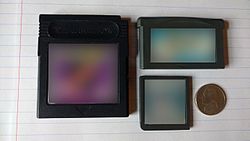
The Nintendo DS is backward compatible with Game Male child Advance (GBA) cartridges. The smaller Nintendo DS game cards fit into a slot on the elevation of the system, while Game Boy Advance games fit into a slot on the bottom. The Nintendo DS, like the Game Boy Micro, is not backward uniform with games made for the original Game Male child and Game Boy Colour because the Precipitous Z80 compatible processor is not included and the console has physical incompatibility with Game Boy and Game Boy Color games.[70] [71] The original Game Boy sound processor, yet, is still included to maintain compatibility for GBA games that utilize the older sound hardware.[ citation needed ]
The handheld does not have a port for the Game Boy Accelerate Link Cablevision, and then multiplayer and GameCube–Game Male child Advance link-up modes are non available in Game Boy Accelerate titles. Only single-histrion style is supported on the Nintendo DS, as is the case with Game Boy Advance games played via the Virtual Console on the Nintendo 3DS (Ambassadors merely) and Wii U.
The Nintendo DS only uses one screen when playing Game Boy Accelerate games. The user can configure the organization to utilize either the top or lesser screen by default. The games are displayed within a black border on the screen, due to the slightly different screen resolution between the two systems (256 × 192 px for the Nintendo DS, and 240 × 160 px for the Game Boy Advance).
Nintendo DS games inserted into the top slot are able to detect the presence of specific Game Boy Advance games in the bottom slot. In many such games, either stated in-game during gameplay or explained in its pedagogy manual, extra content can be unlocked or added by starting the Nintendo DS game with the advisable Game Boy Advance game inserted. Among those games were the popular Pokémon Diamond and Pearl or Pokémon Platinum, which allowed the player to find more/exclusive Pokémon in the wild if a suitable Game Boy Advance cartridge was inserted.[72] Some of the content can stay permanently, even after the GBA game has been removed.
Additionally, the GBA slot can exist used to house expansion paks, such as the Rumble Pak, Nintendo DS Memory Expansion Pak, and Guitar Grips for the Guitar Hero: On Tour series. The Nintendo DSi and the DSi Xl have an SD card slot instead of a second cartridge slot and cannot play Game Boy Advance games or Guitar Hero: On Tour.
Regional division [edit]
The Nintendo DS is region free in the sense that any console volition run a Nintendo DS game purchased anywhere in the world; still, the Chinese iQue DS games cannot exist played on other versions of the original DS, whose firmware chip does non comprise the required Chinese character glyph images; this brake is removed on Nintendo DSi and 3DS systems. Although the Nintendo DS of other regions cannot play the Chinese games, the iQue DS can play games of other regions. Also, as with Game Male child games, some games that crave both players to accept a Nintendo DS game card for multiplayer play volition not necessarily work together if the games are from different regions (eastward.g. a Japanese Nintendo DS game may not work with a Due north American re-create, even though some titles, such equally Mario Kart DS and Pokémon Diamond and Pearl versions are mutually compatible). With the addition of the Nintendo Wi-Fi Connection, sure games can exist played over the Net with users of a unlike region game.
Some Wi-Fi enabled games (e.thousand. Mario Kart DS) allow the selection of opponents by region. The options are "Regional" ("Continent" in Europe) and "Worldwide", also as two non-location specific settings. This allows the player to limit competitors to just those opponents based in the same geographical area. This is based on the region lawmaking of the game in use.[ commendation needed ]
The Nintendo DSi, however, has a region lock for DSiWare downloadable games, too as DSi-specific cartridges. It still runs normal DS games of any region, notwithstanding.
Media specifications [edit]
Nintendo DS games use a proprietary solid country mask ROM in their game cards.[73] The mask ROM chips are manufactured by Macronix and have an access time of 150 ns.[74] [ unreliable source? ] Cards range from viii–512 MiB (64 Mib to 4 Gib) in size (although data on the maximum capacity has not been released).[75] [76] Larger cards have a 25% slower data transfer rate than more mutual smaller cards.[77] The cards usually take a modest amount of wink retention or an EEPROM to save user data such as game progress or loftier scores. Still, there are few games that have no salve memory, such as Electroplankton. The game cards are 35 mm × 33 mm × 3.8 mm (1.38 in × 1.30 in × 0.15 in) (about half the width and depth of Game Boy Advance cartridges) and weigh effectually 3.5 thou ( 1⁄8 oz).
Hacking and homebrew [edit]
Since the release of the Nintendo DS, a dandy deal of hacking has occurred involving the DS's fully rewritable firmware, Wi-Fi connection, game cards that allow SD storage, and software employ.[78] There are at present many emulators for the DS, too as the NES, SNES, Sega Master Organization, Sega Mega Drive, Neo-Geo Pocket, Neo-Geo MVS (arcade), and older handheld consoles like the Game Male child Color.
There are a number of cards which either have built-in wink retentiveness, or a slot which can accept an SD, or MicroSD (like the DSTT, R4 and ez-wink V/Vi) cards. These cards typically enable DS console gamers to use their console to play MP3s and videos, and other non-gaming functions traditionally reserved for separate devices.[79]
In Republic of korea, many video game consumers exploit illegal copies of video games, including for the Nintendo DS. In 2007, 500,000 copies of DS games were sold, while the sales of the DS hardware units was 800,000.[80]
Another modification device called Action Replay, manufactured past the visitor Datel, is a device which allows the user to input cheat codes that allows it to hack games, granting the player infinite health, ability-ups, access to whatsoever part of the game, infinite in game currency, the ability to walk through walls, and various other abilities depending on the game and code used.[81]
See also [edit]
- List of Nintendo DS and 3DS wink cartridges
Notes [edit]
- ^ Japanese: ニンテンドーDS, Hepburn: Nintendō Dī Esu
- ^ Japanese: ニンテンドーDS Lite
- ^ Japanese: ニンテンドーDSi
References [edit]
- ^ "The Existent Cost of Gaming: Inflation, Time, and Purchasing Ability". Oct 15, 2013. Retrieved Baronial 28, 2020.
- ^ "ニンテンドーDS:DSシリーズ本体" (in Japanese). Nintendo. Archived from the original on July 6, 2017. Retrieved February 20, 2022.
- ^ a b c d "Consolidated Sales Transition by Region" (PDF). Nintendo. April 27, 2016. Retrieved April 27, 2016.
- ^ "Sales Data — Superlative Selling Software Sales Units — Nintendo DS Software". Nintendo. March 31, 2015. Retrieved May 24, 2014.
- ^ "Nintendo DS Oft Asked Questions". Nintendo. Archived from the original on January 17, 2016. Retrieved July viii, 2014.
- ^ Darkain (January 21, 2005). "Nintendo DS – WI-FI vs NI-FI". Archived from the original on February 17, 2005. Retrieved Apr 2, 2006.
- ^ "A Pillar As well Many". Feb 23, 2011. Archived from the original on February two, 2015. Retrieved Jan 25, 2019.
- ^ Every bit of March 31, 2016
- ^ "Nintendo DS Line Outsells PlayStation 2, Nintendo Says". WIRED . Retrieved October 13, 2018.
- ^ Yamauchi, Hiroshi (February 13, 2004). "Nintendo DS Invented by Advisor Yamauchi - Interview". Game Online citing Nikkei Shimbun. Archived from the original on Apr v, 2004. Retrieved Apr 19, 2020.
- ^ "Nintendo Going Back to the Basics. Total story about the visitor offering a new system in 2004". IGN. November 13, 2003. Retrieved October iv, 2007.
- ^ a b c "Nintendo Announces Dual-Screened Portable Game Organisation". January twenty, 2004. Archived from the original on Apr ii, 2004. Retrieved July ten, 2007.
- ^ Billy Berghammer (January 21, 2004). "GI Online Interviews NOA's Beth Llewelyn Well-nigh The Nintendo DS". Game Informer. Archived from the original on June 12, 2007. Retrieved July x, 2007.
- ^ Glen Bayer (March 1, 2004). "Diverse Satoru Iwata comments regarding the Nintendo DS". North-sider.com. Retrieved October 4, 2007.
- ^ Kavanagh, Rich (March 13, 2004). "More than Nintendo DS (or Nitro?) specs leaked". Archived from the original on November 6, 2010. Retrieved July 13, 2007.
- ^ Kent, Steve (May v, 2004). "Nintendo unveiling new portable". USA Today . Retrieved July xiii, 2007.
- ^ "Nintendo keeps 'DS' codename, tweaks hardware". USA Today. July 28, 2004. Retrieved July thirteen, 2007.
- ^ "Nikkei talks with Nintendo'due south Yamauchi and Iwata". GameScience. Archived from the original on January 27, 2006. Retrieved May 27, 2014.
"If the DS succeeds, we volition rise to heaven, but if it fails we will sink to hell." — Hiroshi Yamauchi
- ^ Metts, Jonathan (February 13, 2004). "Iwata, Yamauchi Speak Out on Nintendo DS". Nintendo Worldwide Written report. Retrieved May 27, 2014.
- ^ "Message from the President: To shareholders and investors". Investor Relations Information. Nippon: Nintendo Co., Ltd. 2008. Archived from the original on December 21, 2008. Retrieved November 25, 2015.
- ^ Harris, Craig (September twenty, 2004). "Official Nintendo DS Launch Details". Retrieved August 13, 2007.
- ^ "IGN: NDS Japanese Launch Details". IGN. October vii, 2004. Retrieved December 27, 2008.
- ^ "PALGN: Australian DS Launch". Archived from the original on May 25, 2009. Retrieved December 27, 2008.
- ^ "Nintendo claims most successful launch e'er for DS in Australia". Retrieved December 27, 2008.
- ^ Gantayat, Anoop (December ane, 2004). "NDS Launches in Japan". Retrieved July 16, 2007.
- ^ Harris, Craig (January 27, 2007). "Europe DS Launch Title Details". IGN. Retrieved October 4, 2007.
- ^ "Nintendo reacts to DS demand; orders, share price on the ascent". GameSpot.com. November 12, 2004. Retrieved October 11, 2012.
- ^ "Nintendo News, Previews, Reviews, Editorials and Interaction". Nintendojo.com. January 7, 2005. Archived from the original on June four, 2011. Retrieved October eleven, 2012.
- ^ "Nintendo's DS player emerges as Tickle Me Elmo of 2004". Feb 23, 2005. Archived from the original on February 23, 2005. Retrieved October xi, 2012.
- ^ "CONSOLIDATED FINANCIAL HIGHLIGHTS" (PDF). September xxx, 2007. Archived from the original (PDF) on September xxx, 2007. Retrieved October 11, 2012.
- ^ "Nintendo DS targets teens, young adults". NBC News. November 15, 2004. Retrieved May 24, 2016.
- ^ "Competitive Intelligence: The New Sony PSP Handheld: a Articulate Victory of Course Over Part". world wide web.aurorawdc.com . Retrieved April eighteen, 2021.
- ^ "Nintendo DS targets teens, young adults". NBC News . Retrieved April eighteen, 2021.
- ^ Rothman, Wilson (June xiv, 2006). "Time Mag: Gadget of the Calendar week". Time. Archived from the original on July iii, 2006. Retrieved February 1, 2007.
- ^ Schreier, Jason. (Jan 4, 2011) Nintendo DS Line Outsells PlayStation two, Nintendo Says | Game|Life. Wired.com. Retrieved on August 23, 2013.
- ^ McFerran, Damien (May 19, 2017). "Retrospective: The Awkward Nativity of the DS, Nintendo's Most Successful System". Nintendo Life . Retrieved August xiv, 2021.
- ^ Parish, Jeremy (Oct 22, 2018). "The DS saved Nintendo while destroying handheld gaming as we knew it". Polygon . Retrieved August xiv, 2021.
- ^ Jordan, Jon (October 27, 2006). "How DS created a new generation of girl gamers". Pocket Gamer . Retrieved May 19, 2022.
{{cite web}}: CS1 maint: url-status (link) - ^ Frum, Larry. "Nintendo to unveil 3-D gaming console". CNN.com. Retrieved September 6, 2013.
- ^ McWhertor, Michael (January 29, 2013). "Nintendo DS games coming to Wii U Virtual Console". Polygon . Retrieved January 30, 2014.
- ^ Phillips, Tom (June 4, 2014). "Nintendo's commencement DS title for Wii U now available in Nihon". Eurogamer.internet. Retrieved June 4, 2014.
- ^ a b "GBATEK – GBA/NDS Technical Info". Retrieved Dec 30, 2016.
- ^ Furber, Steve (2000). ARM System-on-Chip Architecture. p. 344. ISBN0-201-67519-half dozen.
- ^ "Nintendo DS and Nintendo DS Lite – Wireless Router Information". Nintendo – Customer Service. Archived from the original on June 26, 2007.
- ^ "Take Control" (PDF). Twvideo01.ubm-us.internet . Retrieved September 22, 2018.
- ^ "A guide to homebrew development for the Nintendo DS". Retrieved July 16, 2009.
- ^ "Nintendo DS ni-fi protocol information". Feb 2, 2009. Archived from the original on February ii, 2009. Retrieved September 11, 2012.
- ^ "- Nintendo – Customer Service – Nintendo DS – Charging the Bombardment". nintendo.com.
- ^ Pokémon Diamond and Pearl, Zoo Tycoon DS, SimCity DS, Tiger Woods PGA Tour, Digimon Globe Dawn, Mega Homo Boxing Network five, or The Legendary Starfy
- ^ "Nintendo DS Fitting Guides, NDSL Repair Guides". Consolewerks.co.united kingdom. Archived from the original on November 9, 2012. Retrieved September 11, 2012.
- ^ "Nintendo Online Store". Retrieved Apr ii, 2006.
- ^ "Giving gamers 2 windows to the Web: The Opera Browser for Nintendo DS" (Press release). Opera Software. Feb 15, 2006. Archived from the original on September 9, 2012. Retrieved April 2, 2006.
- ^ Berit Hanson (February 16, 2006). "Opera for Nintendo DS". Berit's Blog. Archived from the original on May 18, 2007. Retrieved July 3, 2006.
- ^ "Marking your calendars: Opera announces Nintendo DS browser release appointment in Japan" (Press release). Opera Software ASA. June 21, 2006. Archived from the original on August 6, 2011. Retrieved June 21, 2006.
- ^ Chris Playo. "Nippon: Nintendo DS Press Briefing". NintendoDS Advanced. Archived from the original on May 16, 2009. Retrieved April ii, 2006.
- ^ Craig Harris (March 7, 2007). "GDC 2007: Nintendo DS Browser US Bound". IGN. Retrieved September 19, 2007.
- ^ "Nintendo DSi Browser at Nintendo :: Games". Nintendo. Archived from the original on Apr nine, 2009. Retrieved June 19, 2009.
- ^ Brian Ekberg (April 14, 2008). "Guitar Hero: On Tour Kickoff Look". GameSpot. Retrieved May 26, 2008.
- ^ "What Is the Divergence between the Nintendo DS and the Nintendo DS Lite? | Nintendo Support". en-americas-support.nintendo.com . Retrieved Jan 22, 2019.
- ^ "DSi Xl Was Once DS Lite XL". Dec fourteen, 2009. Retrieved January 2, 2010.
- ^ a b "Corporate Direction Policy Briefing/Semi-almanac Financial Results Briefing". Minami-ku, Kyoto: Nintendo. October 30, 2009. pp. 9–ten. Retrieved Nov 9, 2009.
- ^ Tor Thorsen (October 29, 2009). "DSi XL hits U.s.a. & European union Q1 2010, DS sales top 113 1000000". GameSpot. San Francisco: CBS Interactive. Retrieved Oct 29, 2009.
- ^ Christopher Dring (October 29, 2009). "Nintendo reveals DSi LL". MCV. United Kingdom: Intent Media. Retrieved November nine, 2009.
- ^ "Mario Kart, Nintendo Wi-Fi Launch". IGN.com. November fifteen, 2005. Retrieved May 19, 2014.
- ^ "Aussie Nintendo Wifi Connection launch details, hotspots and more!". Vooks. Nov 9, 2005. Retrieved January 22, 2022.
- ^ Gantayat, Anoop (October 5, 2005). "Nintendo Finalizes WiFi Plans in Nihon". IGN . Retrieved Jan 22, 2022.
- ^ "The Game Is On As Nintendo Wi-Fi Storms The Earth". GamesIndustry.biz . Retrieved January 22, 2022.
- ^ . Translation. "The Zen of Wi-Fi". Famitsu (in Japanese). March 2006. Retrieved Nov thirteen, 2015. CS1 maint: others (link)
- ^ "Nintendo Wi-Fi Connection service for Nintendo DS and Wii to end in May". Nintendo.com. Feb 26, 2014. Archived from the original on February 27, 2014. Retrieved May 20, 2014.
- ^ "Can the Nintendo DS or DS Calorie-free Play Game Boy Games? | Nintendo DS Family | Nintendo Support". en-americas-support.nintendo.com . Retrieved March 17, 2018.
- ^ "Nintendo - Customer Service | Game Boy micro - Oft Asked Questions". www.nintendo.com . Retrieved March 17, 2018.
- ^ "Dual-slot mode". Retrieved November 1, 2014.
- ^ Vuijk, Rafael (October 11, 2006). "First Nintendo DS cartridge information". Nighttime Fader (Rafael Vuijk). Retrieved February 10, 2010.
- ^ "Nintendo: NDS Disassembly". GainGame'due south Weblog. January 31, 2010. Archived from the original on February 25, 2010. Retrieved February 10, 2010.
- ^ Ni no Kuni: The Another World was the first DS game to utilise a 4-gigabit card "GoNintendo: Level v'south press conference – massive info roundup (Fantasy Life announced, Ninokuni's massive DS cart, and much more!)".
- ^ Adam Riley (July 15, 2007). "E3 2007 News|Archaic Sealed Heat (Nintendo DS) RPG Details". Cubed3.com. Retrieved Nov 4, 2007.
- ^ Sara Guinness (June xvi, 2006). "MechAssault DS Programmer Diary". IGN. Archived from the original on May 9, 2007. Retrieved November iv, 2007.
- ^ Sickr (October iii, 2011). "Nintendo DS: Nintendo Gains 4.8m Million In Piracy Battle, Bans R4 Flash Carts". My Nintendo News . Retrieved March 7, 2022.
- ^ "What Are Nintendo DS and DSi Cards?". Nintendo DS Cards. June 27, 2010. Archived from the original on Feb three, 2011. Retrieved September 23, 2010.
- ^ "ニンテンドーDSの違法コピーにご注意!" (in Japanese). The Chosun Ilbo. Dec eleven, 2007. Archived from the original on February 7, 2010. Retrieved September x, 2008.
- ^ "Datel Trainer Toolkit for Nintendo DS User Manual" (PDF). Codejunkies. 2007. Archived (PDF) from the original on October seven, 2009. Retrieved June thirty, 2021.
External links [edit]
- Official website

When Did The Nintendo Ds Come Out,
Source: https://en.wikipedia.org/wiki/Nintendo_DS
Posted by: crowderroonstank.blogspot.com
0 Response to "When Did The Nintendo Ds Come Out"
Post a Comment